VALUING LIVED EXPERIENCE: Introducing the Collective Voice Interactive Data Tool
Updated: 15 hours ago
Written by Sophie Kendrick from Science Ceilidh (CMWM partner organisation).
Collaboration for Mental Wealth in Moray (CMWM) and fellow community research network Community Knowledge Matter, are excited to share the Collective Voice interactive data tool. Data infrastructure like this tool strengthens the overall community data ecosystem in Scotland by making qualitative data which is the direct voices of people with lived and living experience more meaningful and accessible to others in their community as well as policy makers. In this way, this tool directly promotes mental wealth in Moray and beyond and we’re excited to see how people use it.
How can we advocate for the value of live experience and community data?
Valuing lived and living experiences is integral to the aims of both Community Research Networks - Collaboration for Mental Wealth in Moray (CMWM) and Community Knowledge Matters. This shared value led to the development of an interactive data tool for the Collective Voice project. The tool was developed through a deeply collaborative process between CMWM, Community Knowledge Matters, Moray community members and Moray policy and decision makers.
CMWM partner Moray Wellbeing Hub has been collecting collective voice for several years and sharing the data in written reports. as part of its advocacy approach. Their delivery team members attend drop-in sessions around Moray to discuss community members’ experiences of services and supports, capturing what is working well and could be better around topics such as alcohol and drug recovery. With participant permission, the quotations are sorted into the CHIME framework (Leamy et al. 2011) and shared in a report. CHIME (Connection, Hope, Identity, Meaning, Empowerment) is a values-led framework for recovery shaping the Collective Voice gathering and sharing process, as well as CMWM overall. While collective voice reports are valuable ways of framing collective voice data, the development of the interactive tool is intended to make the data more accessible and meaningful to a diverse audience - both the communities who shared and share their voices, and policy makers who can implement it. Development of the tool involved online and in person meetings, including workshops for community members, partners and decision makers to explore the tool and provide feedback on their experience of the first prototype of the tool. In this way, the collective voice visualisation team aimed to develop a tool which would be meaningful and accessible to all Moray audiences.
The tool includes several distinct tabs designed for Moray community members, and policy and decision makers, to be able to explore the data through whichever lens suits their interests and purposes. Tabs include the CHIME framework, Human Rights-based Approaches, Strengths in the Community, and Barriers and Challenges in the Community.
The human rights tab applies the lens of the PANEL (Participation, Accountability, Non-discrimination, Empowerment, Legality) principles to the Collective Voice so we can better understand how rights may or may not be currently reflected within lived experiences of accessing drugs and alcohol support in Moray as an important cornerstone of policy and practice. However, the tool is ultimately for everyone, including people with lived and living experience, practitioners, third sector organisations and more! It is designed for anyone to be able to explore and understand collective voice regardless of prior knowledge of community data, CHIME, or rights-based frameworks. Exploring the collective voice through the interactive tool is highly customisable with a search feature, theme filters and the ability to save quotations of interest to your bookmarks. The tool also includes many accessibility and orientation features, such as a ‘Start here’ page explaining the various tabs, a tour of the tool, a reading guide tool, text size increase and decrease options and inverted colours.
The interactive data tool also includes an Impact page which shares stories of change, connection and meaning stemming from the collective voice work. Prior to the tool development the collective voice work when used in strategic spaces advocating for the value of lived and living experiences, had no way to celebrate this and share with the wider community. The impact of the interactive tool in particular was felt during the workshops exploring the first prototype. Community members who have been involved in sharing or using collective voice data shared how the tool brought their words and experiences to life and how meaningful it was to see the project made even more accessible.
Community data ownership, data accessibility and meaning, as well as the valuing of lived and living experiences are directly supported by this tool. We’re also excited to see how versions of the tool could prove useful for other community research projects and networks and could help connect different community data sets together in shared advocacy, aims and understandings. Fellow Community Research Networks would also be able to share their data in a format that is meaningful and accessible for their audiences.
When more community members, decision makers and partners truly understand and connect with lived and living experience, this can bring new insights and perspectives which can’t be found in other approaches. Prior to developing the Collective Voice Visualisation tool, Community Knowledge Matters was able to do just this, creating an interactive data tool for data gleaned from a co-produced survey about rural priorities for mental health research through funding from the Ideas Fund and Wellcome. This tool is designed to give ownership over the data for those who took part in the survey, as well as make the survey results more meaningful and accessible for others. Drawing on learnings from the development of the Co-Priority Survey tool, Community Knowledge Matters worked with CMWM to create a bespoke tool for the Collective Voice and the approach has been mutually beneficial across the projects.
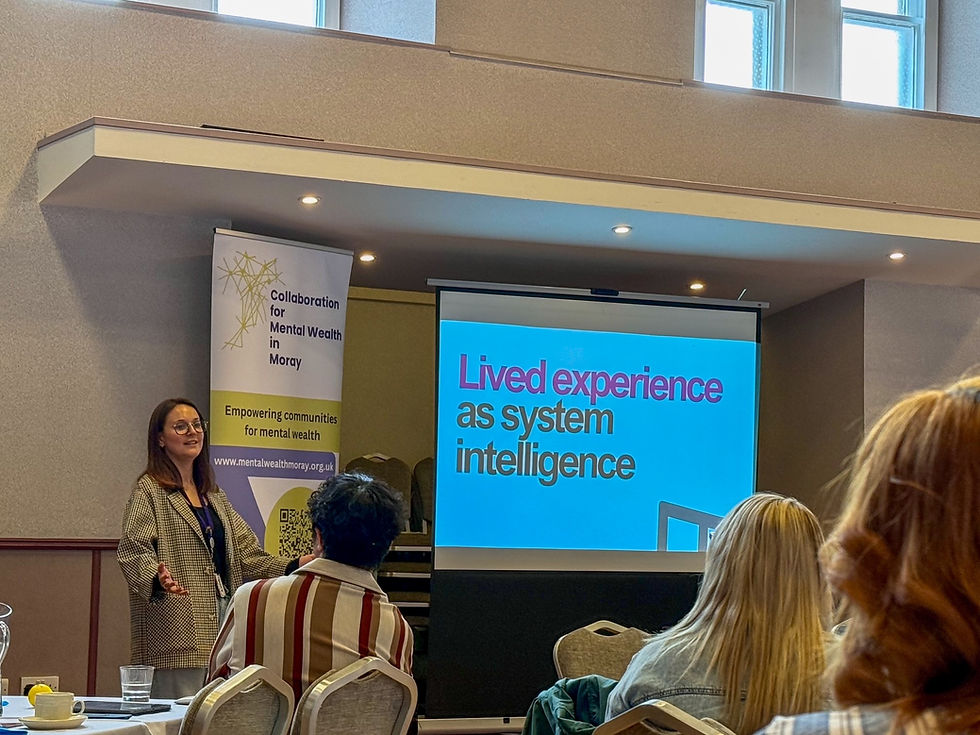
As development progressed, collective voice project team was fortunate to have been able to meet in person in Elgin, as well as frequently online. In June 2026 at an in-person event the beta of the tool was launched to an enthusiastic group of Moray community members, local decision makers and CMWM partners. We spent this meaningful day discussing rights-based approaches to drug and alcohol supports and services and how such approaches support community data and lived experiences. As a group, we explored the tool and discussed the ways in which it was effective as well as how it could be more accessible and useful. After amending the tool’s initial beta based on feedback from the launch event, the Collective Voice interactive data tool is now publicly available!
Throughout the process of developing, refining and launching this tool, we have discovered the work that must still be done to ensure community voices and experiences are taken seriously. Applying lived and living experience to policy, supports and services continues to be challenging in many instances - it’s important to be clear what the data itself is, be open with the expectations and who it serves. We have found that we need to continue emphasising rights-based approaches to mental health and drugs and alcohol support in particular. It is clear that advocating for the use and implementation of the Collective Voice tool and data is one essential way of supporting this challenge. Data infrastructure like the interactive data tool strengthens the overall community data ecosystem in Scotland by making data more meaningful and accessible to those who may not have existing knowledge on a given research topic. Collective data infrastructure also demonstrates that community research can be just as structured, accessible, and valuable as traditional academic data.
Going forward, the collective voice project team will continue to consider the feedback of those who utilise the interactive data tool and develop the tool to be the most meaningful and accessible it can be. We will also continue advocating for the value of lived and living experience for informing decisions and planning in policy making, health and social care and third sector spaces, especially through the lens of human rights. We hope you take the time to explore this tool and would love to hear about your experience diving into the Collective Voice!

Quotes of Impact
“For someone who has been quite closely involved in gathering collective voice, this is very exciting as [it’s] so much more tangible and also [has a] longer lasting effect.”
“This is great, and ties into exactly what I meant by the 'So what?' element of Collective Voice."
Part of the Collaboration for Mental Wealth in Moray (CRN), funded by UK Research and Innovation (UKRI) and The Young Foundation.
Hosted by Moray Wellbeing Hub CIC, the Collaboration for Mental Wealth in Moray is a network of partners who are researching what works for creating mental wealth in Moray through the co-creation of solutions and community-driven action. Partners in the network are the Digital Health & Care Innovation Centre (DHI), tsiMORAY, Science Ceilidh, Arrows (A Quarriers Service), Earthtime for All, and Grampian Regional Equality Council (GREC).